“Street drugs”: A confusing noun!

mluemsa Par Le 09/05/2023 à 10:32 0

Dans Santé

Health

Although many people say they were satisfied after buying a medicine on the street, this does not always certify of the quality of that medicines, even taking into account that, some medicines from the official marketing channel also end up in informal outlets selling medicines of dubious origin. Image: static.allodocteurs.fr


Analyze/Street drugs kill! This is the refrain that we are used to listening particularly during awareness campaigns against a reality which is not only the source of numerous public health problems, but also considerably threatens the economic growth of African countries in particular, because if the phenomenon is global, the African continent is according to the World Health Organization, the space where are sold the most what we call particularly in sub-Saharan Africa, "street drugs", but which the World Health Organization rather calls "substandard medicines or falsified medicines”

A same reality called in different ways, to reflect the dangerous nature of these drugs which are still marketed despite everything, in commercial areas of sub-Saharan Africa. If, as an article published in July 2019 on the website of the daily newspaper Le Monde specified that the terms used by the WHO are more adapted to public health issues, given that the old term used was "counterfeit", to say that these are medicines which do not comply with quality standards, in sub-Saharan Africa, and in Cameroon in particular, people have chosen to adopt the term "street medicines or street drugs", not by carelessness or lack of awareness, but because they are equally aware of the issues surrounding the marketing of these drugs with dubious origins in human health, even if the fact that they are still marketed despite multiple awareness-raising efforts seems to say the complete opposite.

“Street medicines” therefore refers to the contextual adaptation of a universal reality that encompasses not only what comes from official drug sales channels, but also from those of dubious origin, which many have chosen to market in the streets or better still, in full view of everyone, despite awareness-raising and repression efforts, because as the president of the Order of Pharmacists of Togo clarified in 2019 to journalists from the daily Le Monde, “Sub-Saharan Africa concentrates all the vulnerabilities which will favour inferior or falsified medicines: the weakness of the governance of health systems, an insufficient supply of care and a network of pharmacies on the territory, the existence of an almost tolerated parallel market, and the poverty of the populations”, are the reason for the marketing of street drugs, which although considered dangerous by experts, remain because consumers have partly chosen for it to be so, despite everything, because if the authorities chose not to take into account these assumed favourable choice linked to a particular social contexts, the muscular operations would surely have considerably reduced the prevalence rate of this mercantile activity in African societies.

The evil therefore persists because a good portion of the populations of sub-Saharan Africa in particular, have chosen to adopt “street medicines”, because they believe that these are good medications. And that's where all the confusion lies. Indeed, faced with the opinions of experts who encourage States to eradicate this scourge by prohibiting their marketing in particular, the persistence of this lucrative activity in the streets, due in part to the fact that populations continue to buy them in the streets, poses a problem which is justified in part by the low purchasing power of populations, and because several drugs from formal marketing circuits are found in the streets or in these informal sales points recognized as being places for marketing drugs of dubious origins or those for which we do not always have certification of quality, because consumers for the most part, are very often satisfied only with the opinion of sellers or resellers whose answers can only be a way of making a good impression, so as not to miss an opportunity to get a good deal. But to be sure of the quality of the medicines you buy, you must go to approved points of sale which are none other than pharmacies, because by going to get supplies in the streets, there is a strong possibility of buying potentially dangerous medicines, because we do not know their true origins or if they are really of quality, and without short and medium term consequences on the health of the population. Indeed, although many people say they were satisfied after buying a medicine on the street, this does not always certify of the quality of that medicines, even taking into account that some medicines from the official marketing channel, also end up in informal outlets selling medicines of dubious origins. A way of saying that if these drugs can kill people, they can also be of good quality, to the extent that there are people who find satisfaction after purchasing them, as to say that not everything that is sold on the street is of poor quality. And it is precisely this bit of satisfaction that pushes many buyers to return again and again that promotes this confusion which is reflected in particular by the persistence of the presence of these drugs of dubious origins in the streets, as if to say that they are not dangerous, when in reality they are, to the extent that those who sell them have not received any certification, and do not have formal authorization to sell these potentially dangerous products in the streets. In other words, they are not authorized to sell medicines, whether of good quality or not, in informal sales outlets. What they sell to consumers has not been authorized by any competent authorities, even if certain drugs from the formal drug sales circuit can be found there. If quality medicines can also be found there, they are not appropriate places for this type of medicine, to the extent that it is a way of confusing consumers or leading them to adopt dubious and less expensive local choices which are certainly satisfactory, but which can have a terrible downside, especially when we do not really know the composition of what buyers consume, despite the dissuasive nature of the point of view of sellers who are not those of the most authoritative voices whose speeches on the subject are also a way of getting consumers to take their responsibilities, and not consume just anything, even if their presence despite the prohibitions seems to give the feeling of hesitation on the part of the highest authorities which can be partly explained by the fact that there are people who buy drugs in approved points of sale, to resell in other unapproved points on the one hand, and because they, (speaking of these high authorities) are aware of the fact that the populations do not always have the means to buy medicines in pharmacies, and are therefore very often forced to look for medicines which attack the same causes in informal local sales points where products of dubious origins are sold at lower cost, and even in detail, unlike what is done in pharmacies in the other hand.
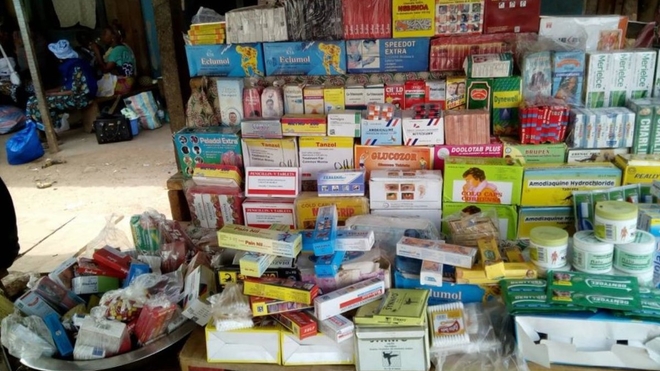
Everything that is sold in spaces other than authorized points of sale is always frowned upon, and judged on the basis of appearances which expose the owners of these illegal sales points to the devastating effects of muscular raids which aim not only to protect the health of consumers. Image : le monde.fr - SIA KAMBOU/AFP

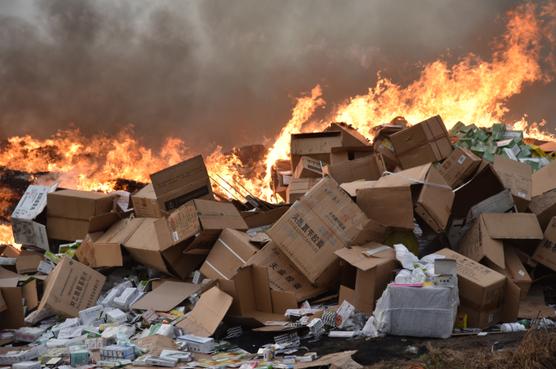
But as long as we do not have a sales authorization, doubt and confusion will always persist. This is why many experts in natural and traditional medicine choose to have sales authorizations or more precisely to place their activities within a formal framework. They do not prescribe certain medications without having done or seen examinations, especially for treatments that require very specific monitoring. Indeed, if there are medicines which are sold only by prescription, to say that the customer is followed by an expert, the fact of adopting measures aimed at not selling certain medicines haphazardly, gives more credibility to the exercise of an activity which requires dissociating itself from other ways of doing things which give rise to confusion, because for multiple reasons which have no reason to exist, many have made the choice to continue to market medicines of dubious or falsified origins which should not just be judged based on appearances or on the fact that everyone sees them on the streets. In addition to the ban for lack of sales authorizations, control is also required, because when we want to prohibit the sale of food or agri-food products, we do not just say that it is because they are sold in the street, but because we have formal proof that they have dangerous components and that they are poorly manufactured and poorly preserved. Furthermore, the fact that they are sold in informal outlets is not sufficient proof of their poor quality. The destruction of these potentially dangerous medications must not be done on the basis of nothing or appearances, but on the basis of several proven facts which are not limited to taking the necessary measures, in order to stop what is creating a shortfall in formal drug sales channels. It is also about ensuring that what is of quality is no longer found in informal points of sale without authorization, because it is realities of this kind which also give rise to confusion. Municipalities must therefore no longer encourage this confusion by simply collecting taxes from sellers of these products, but ensure that those who operate these businesses have sales authorizations because everyone is concerned. Indeed, when we simply take money from those who are prohibited from being in a specific space, and in an informal setting, it is a way of turning a blind eye to the subject or of recognizing that the quality of these medications is good. And even if we should not doubt the potential veracity of this particular point of view, it must always be pointed out that these are not appropriate places for the sale of quality medicines, because everything that is sold in spaces other than authorized points of sale is always frowned upon, and judged on the basis of appearances which expose the owners of these illegal sales points to the devastating effects of muscular raids which aim not only to protect the health of consumers, but also to prevent pharmacies from experiencing losses, due to the presence of these informal circuits in contexts where the activities of the informal sector play a very large role in the gross domestic product of developing and middle-income countries. A reality which does not take away from the fact that “street drugs” or more precisely those sold in informal settings are potentially dangerous, because the experts are clear: “these drugs are dangerous.” And these are not statements based on appearances, but on a set of analyses of tangible facts leading to the conclusions that most of these drugs are manufactured without active ingredients, or with other active ingredients than those normally used. This is how an antidiabetic drug was found in March 2019 in a medicine against hypertension in Cameroon. This means that it is not wise to limit ourselves to the level of the presence of a medicine at an unapproved point of sale to attest to its bad quality. These are assertions that must result from a series of serious investigations, because it is entirely possible to find quality medicines there, even if this is not a reason to encourage the sale of these potentially dangerous medicines to the extent that in addition to their dubious origins, there are also the bad manners of storage, and the lack of training of sellers, which expose potential customers to certain death.

According to the World Health Organization, a counterfeit medicine is one whose “identity and/or origin is deliberately and fraudulently falsified, whether it is a registered brand product or a generic product."

One of the prevention methods used by health specialists to help users avoid being the main cause of the ailments that afflict them, consists of dissuading them from obtaining medicines from unauthorized points of sale. Is it to favour a particular sector or simply to raise awareness about the existence of the marketing in our societies of counterfeit products which constitute a social danger?

Considered by some as the best way to regain health not only because of their proximity to the common people, but also because of their very affordable costs compared to those sold in pharmacies in particular, "street medicines" or those sold in unapproved points of sale in sub-Saharan Africa, deserves to be better understood, to avoid the amalgams conveyed by points of view that could lead to confusion.

Literally and even in a basic way, medicine is what makes it possible to recover or improve the quality of health capital that must be taken care of. The street for its part is a traffic lane. By associating the two words so as to obtain a group of words, we realize two things: firstly, by limiting ourselves within the framework of the exercise of an informal activity very widespread in sub-Saharan Africa, it is a set of products which are not or no longer part of the regulatory circuit of manufacturing and marketing of medicines. Secondly, these are products that belong to the street. But given that the street as a material object or way of circulation cannot produce medicines or does not have medicines of its own strictly speaking, we conclude by saying that it is a set of products which have either by prohibited means or not left the formal circuit, to find themselves in another informal one, or either medicines produced fraudulently in non-certified establishments, then transported and marketed illegally, in the streets or unapproved marketing points of medicines of doubtful origins for more details.

Also read: Quality medicine: Between charlatanism and imposture, a cure and discernment is essential 

According to the World Health Organization, a counterfeit medicine is one whose “identity and/or origin is deliberately and fraudulently falsified, whether it is a registered brand product or a generic product." But is the simple fact that they are found on the street certify that they are counterfeit or dangerous for health? Not at all, for two reasons: firstly, if we take into account the fact that a quality product can be found illegally or not on the street, we cannot say that this product is dangerous for health. Secondly, in countries where the informal sector is the main source of income, many people choose to obtain medicines from conventional sales outlets, in order to supply or resell them in the outlying districts of large cities and villages. It is also important to underline that certain products made from natural plants, are also sold on the streets or by itinerant salesmen. The street has never kill anyone. It is Men who take advantage of the streets, to exercise dangerous activities. It is Men who must be incriminated, or even condemned, if he chooses to persevere in the marketing of drugs qualified as dangerous following a series of summary and in-depth analyses. You cannot arrest a person based solely on the fact that he is selling products on the street, without knowing whether these products are good or bad. The informal sector must be further supported, so that it can also truly contribute to the eradication of fake medicines on the streets. Instead of saying "street drugs", it would be better to say counterfeit drugs or drugs of dubious origin, sold in unapproved points of sale, and potentially dangerous.

English|French


Ajouter un commentaire

Anti-spam