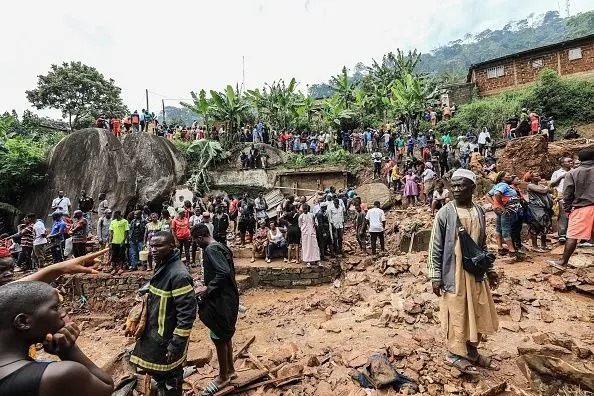
Many are those who predict that the next war in Cameroon will be linked to land ownership, if it isn't already the case. Are they right or not? We don't know! But the arguments and examples on which they base their point of views, should be taken very seriously, especially in a geographical context where, when some struggle in vain to legally acquire a plot of land for financial and administrative reasons, others can afford exorbitant areas which raises questions, especially when houses are demolished for a public utility cause that later, turns out not to be the real reason for this incongruity, because many are those who in the name of power and money, can afford themselves to treat certain segments of the population as they please, on a national Territory where the land belongs to the people, and is managed by the State; that is to say, a minority of privileged elected and appointed people, who have the duty to serve populations who very often wonder if these Mens are really at their service, especially when people find themselves homeless, following the torrid implementation of a law which is very often instrumentalized by the strongest, in order to further increase the precariousness of the existence of the poorest, who often have nothing but only their eyes to cry, when they are victims of an eviction operations without any leniency towards Cameroonian citizens, who only want to have a roof over their heads, in a geographical context where as in many others, access to decent housing is a luxury that not everyone can afford.
A very difficult social situation at the base of a feeling of bitterness, often exacerbated by the fact that, faced with such an overwhelming scenario where thousands of Cameroonians are dispossessed of everything overnight for "public utility," no urgent alternatives are offered to them immediately, by a government that sometimes gives the impression of being indifferent when Cameroonian citizens are treated as individuals without rights. Indeed, the brutality of the demolitions or evictions sometimes gives the impression that, for the competent authorities in such circumstances, the future of the evicted populations matters little or not at all, perhaps because, for these authorities, those who are evicted, are a conglomerate of undisciplined people who deserve to face the full force of the law, as if seeing streets teeming with homeless people is a pleasant prospect. If we are all indeed proud to see a city evolving thanks to several courageous and necessary initiatives, given the unsanitary conditions of some areas, and even the cramped conditions in which arbitrary garbage dumps and haphazard constructions coexist, it must still be said that, it is always wise to show concretely an act of compassion for the victims who are not only human beings, but also Cameroonians with rights, that those responsible for the destruction more often don’t take into consideration, especially when elections are not imminent. In fact, eviction operations are generally never undertaken a little time before electoral campaigned, but rather afterward, because electoral campaigned period is a time where those seeking to be elected, and those seeking for a re-election, do everything in their power to win the people's favour, without however, clearly detailing their development plans, which primarily require some destructions and evictions. It is only when the election period ends, that the harsh application of the law is implemented, showing no mercy towards those who for authorities responsible for evictions, constitute an obstacle to a modernization process that should nevertheless, be accompanied by some temporary and satisfactory measures. Why? Because the people targeted by the law and who are dispossessed of all their possessions under the pretext that firstly, they lack documents proving their ownership of these properties, and secondly, that they no longer have the right to be there for reasons of public utility among others, are still human beings with rights. Indeed, those who give the authorization to destroy people’s houses, are often proud to highlight the fact that those they force to leave one place or another, have not land titles or building permits. They said it because they know that, nothing will contradict their statements. But what they don't so proudly admit publicly, is the fact that, the system to which they belong, is partly responsible for the expansion of that critical social situation which they must not put an end, without demonstrating concrete acts of appeasement, through alternative and temporary measures of utmost importance, in a Territory that possesses a large legal and institutional framework to protect human dignity which is nothing other than the fundamental, unconditional, and equal respect due to every human being, regardless of their differences or social status.
Indeed, almost everyone is proud to contemplate the splendour of a land use planning that beautifies the urban or rural environment. The problem is not the land use planning in itself, but rather the damage caused to the victims of that land use planning. The implementation of a competence that considers the situation of all social strata must always be accompanied by alternatives that at least, allow victims to have a temporary and useful solution. If any land use planning can leave a bitter taste, the harshness of this taste can at least be reduced by concrete measures aimed at helping victims feel involved in a development project that requires a consent of circumstances which however, is not entirely free because, after being dispossessed of their properties, many will need immediate and temporary assistance, which those responsible for that expulsions and destructions more often don’t take in consideration, because the social consequences of their actions on the daily lives of Cameroonians is not their problem. Even if evictions and destructions for a cause of public utility can be explained by the application of a law that applies to everyone, nothing justifies the use of the law's absolute power to expropriate residents without offering alternative solutions. To act in this way, is to demonstrate a lack of humanity that constitutes an infringement on one of an individual's fundamental freedoms: the right to lodging.
This is something that the ruthless application of the law always chooses to disregard, because it must achieve specific objectives that do not consider the fate of those who are at the root of urban population growth, which allows them to earn a better living. Even in rural areas, many are those who, depending on the context and the specific nature of their situation, feel that for them, the countryside or rural area, is not the most favourable place to better met their needs in a daily basis. Overcrowding, precarious living conditions, poverty, population growth, and unsanitary conditions in urban areas in particular, are justified by the fact that cities are overflowing with people seeking a better life they were unable to find in rural areas, and which they hope to find in a urban milieu destined to present a completely different landscape over time, depending on the financial resources at the disposal of those responsible of the execution of land use planning projects, which must take in consideration the future life of victims of that evictions and destructions because, acting without leniency, is tantamount to telling those evicted to settle anywhere but not here! That is to say, to return to their villages, while implicitly encouraging them to settle on the outskirts of large cities, and even in high-risk areas if they so choose, while awaiting the next natural disaster, or the next scorching exercise of law on the outskirts of these large urban areas.
If this failure can be assimilated to a way of mocking of the fate of the victims of that evictions and destructions, it reflect also concretely, the lack of attractiveness of rural areas, coupled with the inability of leaders to retain as many people as possible in these geographically areas which are very important on economic growth of a State. These populations therefore, find themselves in very large urban areas, thus increasing unsanitary conditions and uncivil behaviour, which cannot be resolved solely through evictions, but rather through the increasing implementation of attractive measures in rural areas, in order to further encourage as many people as possible, especially young people, to contribute to the economic growth of the Territory in these remote areas where we find under-exploited and untapped natural potentialities, due to a lack of financial resources. If it must be said that the ongoing decentralization process has led many party members and sympathisers to use constantly the transfer of powers or competences as an election campaign slogan, it is also important to note that, this transfer of skills or competences is not always accompanied by the necessary financial resources without which, elected officials cannot better manage their localities. And when that elected officials said they need more money to do what they have to do, the answer which is given to them is: the transfer of competences means you must also find the financial resources by yourselves. Something that they know very well, but which doesn't prevent them from demanding their rights at the Territorial level because, the implementation of a range of development projects requires considerable financial means that international partners cannot fully support. Hence the importance of local financing, especially in a context where, following an official declaration by the Head of State, elected officials are still demanding a share that should be allocated to them, and which is always postponed, as if it were a promise made lightly, just to mock the intelligence of certain people, or even to build the future on promises that we have no intention of implementing on time, while we are serving a people who expect a lot from us, and who have now made a habit of expressing it strongly during elections, because the people have a right to vote that they are now determined to used more better in the future, in order to express more their dissatisfaction toward their leaders because, even if Cameroonians in particular have the bad tendency to build anywhere, and in any way, their case or their problems related to housing and land in particular, must be treated with the utmost care, as if they were victims of a natural disaster in a high-risk area where even if land titles and building permits will never be granted to those who live there, the authorities know that they must do something not only because it is the entire Cameroonian Territory which is grieving, but also because these are Cameroonians who find themselves, in an even more precarious situation.


 Par
mluemsa
Par
mluemsa