Development of transport infrastructure in Cameroon: a long and promising process at the speed of a turtle.

mluemsa Par 0

Dans Dossiers

Dossier

Building a road is not enough; the project must also be sustainable. Indeed, expert’s note that, a high-quality road can last 10 to 20 years, provided there is constant maintenance. And such upkeep or maintenance is crucial because, without timely or progressive care, the isolation and hardships of the past, will inevitably return sooner than expected. Image: 237infos.net

"This road is not merely a path; it is a route to progress, prosperity, and hope for our children..."

Where the road goes, development follows. We are all familiar with this adage, which links the economic growth and social well-being of a region's population, to the implementation and ongoing maintenance of transport infrastructure. We know this expression which translate a degree of satisfaction, which moves beyond abstract promises of an upcoming project that is slow to materialize, allowing communities to view the future with optimism. We also know how the construction of a national, a regional, a departmental, or a communal road can brings population to have an optimism which, depending on the geographical context, point out the end of decades of hardship, for communities and villages once far removed from paved roads.

But what we do not always understand is why it takes so long to pave a road network with asphalt or bitumen? Why, even with myriad of economic potential, do many road projects still lag behind? Why does the daily reality of the daily life of those who live in certain towns and rural areas characterized by bad roads and streets, give the impression that, those responsible for serving the public interest, are not doing what they were appointed and elected for?

One of the reasons which explain these hard reality can be linked to the age of the Republic of Cameroon. 66 years old of existence as a State which represent also at least, six decades of construction and renovation which have nevertheless yielded satisfactory results, even if we must also said that, what has been achieved, pales or represent nothing in comparison to the work that remains to be done.

"Cameroon’s first roads date back to the colonial era. Since independence, public authorities have established a modern road network. Even though they are praiseworthy, these initiatives have not solved the problem of connecting the hinterland and urban centres, which remain underserved. Consequently, traffic jams and road accidents are a daily reality for road users. Road maintenance requires massive capital investment. To ensure the investment pays for itself at the right time, proper maintenance of road infrastructure and responsible use by the public are essential. Yet, it must be acknowledged that, this is not always the case in Cameroon. — Leoni Djike Dongmo / Nkafu Policy Institute – December 20, 2016

Unlike older civilizations which had more time and greater technical and financial resources to build, and even rebuild themselves (notably after World War II), most African States are young independent nations whose the gaining of sovereignty, marked the beginning of a new era that necessarily required developing roads infrastructures, in order to foster growth.

And since not everything could be done at once or in one time, priorities had to be set, as is customary. Reason why, while some communities enthusiastically used the road networks deemed priorities by the governments of that epoch, others were still waiting for the day paved roads or bitumen would reach their localities areas, that continued to languish in a stifling isolation, synonymous with hardship and underdevelopment.

And among the communities awaiting the day where paved roads or bitumen would reach their localities areas after more than 65 years, are the people of Yoko, in the Mbam-et-Kim division of the Centre Region. The satisfaction expressed by their mayor following the inauguration of the Batchenga-Ntui-Yoko-Lena-Tibati funded or financed by the African Development Bank, reflects the sentiments of these residents, who now view the future with a great satisfaction.

"Thanks to the construction of the Batchenga-Ntui-Yoko road, our agricultural, commercial, and entrepreneurial activities are experiencing a new surge. This road has transformed our daily lives. It has made accessing markets easier for us. Moreover, the women of Yoko have benefited from training in resource and business management, which has enabled us to enhance our skills and make them more profitable. We are now better equipped to actively contribute to our region's prosperity." — Agnès Attah, President of the Yoko Women's Network.

However, building a road is not enough; the project must also be sustainable. Indeed, expert’s note that, a high-quality road can last 10 to 20 years, provided there is constant maintenance. And such upkeep or maintenance is crucial because, without timely or progressive care, the isolation and hardships of the past, will inevitably return sooner than expected. Efforts must therefore be stepped up, to rehabilitate and expand road networks where the need is greatest, because in addition of the fact of giving satisfaction to user, a quality road also allow the State to make cost-cutting or to economise, because given the high cost of new road construction, it is far better to maintain existing roads progressively.  

“The rehabilitation and widening works fall within an intermediate range. On the Maroua-Moutourwa, Magada-Guidiguis, and Guidiguis-Yagoua sections, the costs fluctuate around 498 million CFA francs per kilometre. These amounts confirm a trend observed in many African countries: rehabilitating an existing road generally costs 30% to 50% less than building a new one.” (Grands Chantiers du Cameroun – May 2026 Edition)

The current state of Cameroonian alleyways, streets, and roads, clearly demonstrates that, without ongoing maintenance, the road network is destined to deteriorate progressively, especially in our societies where, according to geomorphologists, road construction must take greater account of the intensity of traffic on these priority routes, in addition to the imperative need for regular and continuous renovation work, so that a small crack does not become a pothole.

"Climate is a major factor in the deterioration of our asphalt roads and parking lots. Temperature variations, freeze-thaw cycles, Heavy rains can also damage the very structure of the asphalt. Cracks appear more quickly in regions with significant temperature variations (…) A single truck puts as much stress on the road surface as 2,000 cars. That's why it's important to consider traffic density before construction of a road. A road's lifespan is 10 to 20 years, provided the cracks are filled. » Via Patch

Ten or twenty years, provided the cracks are filled. This means that many of our roads, now over thirty years old and resembling spaces reserved for obstacle courses, are in such a state, because they haven't been properly maintained. This means that, government focused more on the present, without considering what will happen to actually degraded roads and streets in the future. As a consequence, many streets and roads todays are in a bad state which is one of the reasons for the discontent of Cameroonian transporters who recently, following consultations which according to the leaders of the national road haulers' union, the president of the national road drivers' union, and the vice-president of land transport association, was satisfactory. Hence their choice to call off their strike, acting on the promises made to them by the government, particularly regarding the renovation of roads, along several routes across the country.
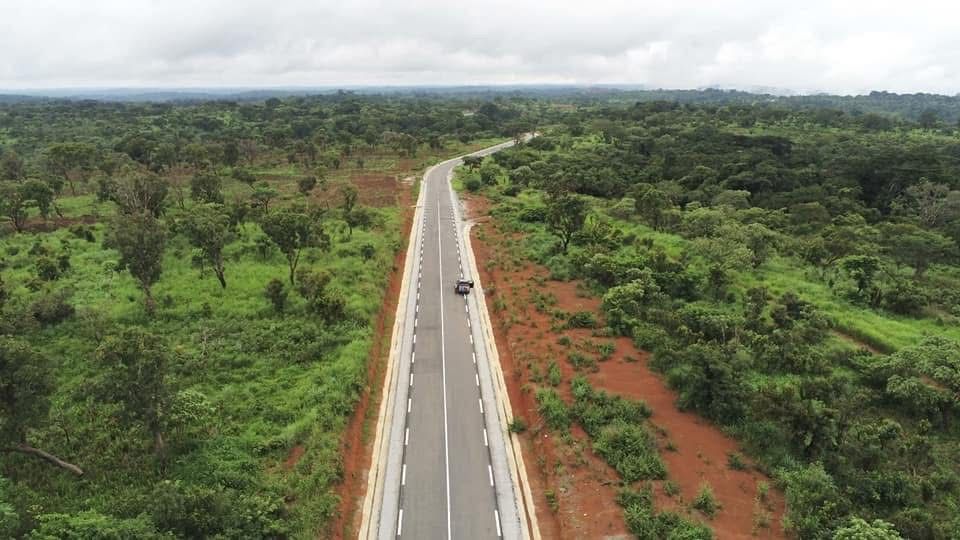
The reasons of the bad state of our streets and roads, is also more linked to funding issues, which are very insufficient. Image : économie du cameroun (EDC)/ Novembre 2024

The government must therefore make further efforts, to better promote the social well-being of the population, and boost GDP growth, which relies heavily on the road network. Indeed, even if Cameroon Territory is also characterised by rail and maritime networks, in addition of the existence in the Territory of several international airports, road transport remains the most widely used, and the most cost-effective or lucrative mode of transport. It means that, the Cameroonian economy is heavily dependent on roads, whose quality leaves much to be desired.

Be that as it may, the process of building and renovating road infrastructure in Cameroon, is set to continue with his lot of insatisfactions. Indeed, between old roads that require complete reconstruction, and others slated for renovation which, due to poor oversight, risk needing also total rebuilding, we can say that, the task is immense because, in addition to the long weary wait endured by the populations of Malimba, Yébé, Konjock, Makombé, Dabanga, Ndobian, Evondo, and Moutourwa among others, it is clear that, the queue of demands on the table of the government and local councils offices, is endless because Whether it’s national, regional, departmental, or communal roads, each level carries a burden of dissatisfactions, which bring people to ask to themselves if their leaders truly care about the public interest of the nation because, when such problems pile up, many are those citizens for whom, it is because of two specific and seemingly incurable ills, plaguing Cameroonian society; namely corruption and the embezzlement of public funds. These are two blights or diseases, which threatening every stratum of Cameroonian society. And in the view of many, they are primary causes of the poor quality of our roads and streets.

But if we must acknowledge, as the country’s leading institution acknowledged that corruption and the misappropriation of public funds are ills which threatening our economies and societies, we must also recognize that, the reasons of the bad state of our streets and roads, is also more linked to funding issues, which are very insufficient.

"Public resources are not infinite. Budgetary constraints exist and weigh on the State’s investment capacity. Yet, we must also face reality: despite these limitations, public authorities continue to invest in infrastructure essential to the country’s economic transformation. In the road sector, for instance, several major strategic projects are currently underway, such as the rehabilitation of the Ngaoundéré–Garoua route, and the development of the Mora–Dabanga–Kousséri road in the Far North. We also have the network renovation works in the Northern regions, which testify of the ongoing efforts of the Ministry of Public Works (Cameroon), to modernize a road network that now exceeds 18,000 km." — François Eyene Eyene, Editor-in-Chief of *Grands Chantiers du Cameroun* (Editorial excerpt from the 96th Edition – May 2026)

Thanks in particular to the dissemination or diffusion of information regarding ongoing projects, Cameroonians are well-informed about what is ongoing in the ground, and what is not. They know that, there are projects that have been abandon for various reasons, and other which are currently underway. However, what concerns them most is the slow pace of implementation. if it must be acknowledged that, factors such as adverse weather conditions and budgetary constraints, can contribute to delays in certain regions, and that poor service delivery is one of the major cause of rapid deterioration, particularly for communal roads, it must be say that, the primary concern for Cameroonians, is the extensions to budgets and timelines failing to meet project deadlines or completion dates, which give the impression that in Cameroon, a single day is akin to a month or a year. Indeed, numerous infrastructure projects have received additional funding and schedule extensions, without ever reaching completion.

And such a situation does not improve well-being of populations, particularly in a context where the population are very demanding because whether in rural or urban areas, the bad quality of streets and roads, have a bad impact on their daily lives. If making ends meet; that is to say, being able to honestly satisfy basic daily needs is already difficult, the deplorable state of much of Cameroon’s transport infrastructure makes this daily challenge even more complex, especially for those involved in the production and sale of fresh produce. Indeed, when transporting products to points of sale becomes a daily ordeal, it is normal for population to show their discontent or dissatisfaction to those responsible for managing transport routes in both city centres and outlying areas.

Even though farming in Cameroon has huge potential, it faces many problem that slow down its growth. One of the biggest problem is that, there aren’t enough good roads. It’s hard and expensive to move farm products from the field to the markets. This means a lot of food goes bad before it can be sold. Kevin Boumal – novembre 2025 – blog.agrifrika.org

The numerous significant efforts undertaken by the Cameroonian State to increase the mileage of paved roads, and improve the quality of urban thoroughfares or streets through decentralized local communities, leave much to be desired. From the time when gaining independence in 1960, the total length of paved roads in Cameroon, according to a 2021 report by the department in charge of public works, stands at approximately eleven thousand kilometres [11,000 km], out of a road network estimated at over one hundred and twenty-one thousand kilometres [121,000 km]. That represents 9.09%. and concerning urban streets, their state of disrepair and near-nonexistence, stem from two factors: on the one hand, rapid population growth, and on the other, the inability of a certain segment of the population to secure housing that aligns with the requirements of proper urban planning, have exacerbated the problem of haphazard construction, and suffice to demonstrate just how lacking the country is in quality transport infrastructure.

Local populations have goods but cannot easily bring them to market, not because roads are non-existent, but because there are too few quality roads. Image : fr.journalducameroun/Esther Fossi Janvier 2023

To explain the shortage of quality transport infrastructure in Cameroon, official sources cite in particular, funding constraints and security issues in several regions. If these reasons are valid, they nonetheless raise a question: must we not acknowledge that, in several points particularly regarding the construction, rehabilitation, or renovation of road infrastructure, the government has partially failed?

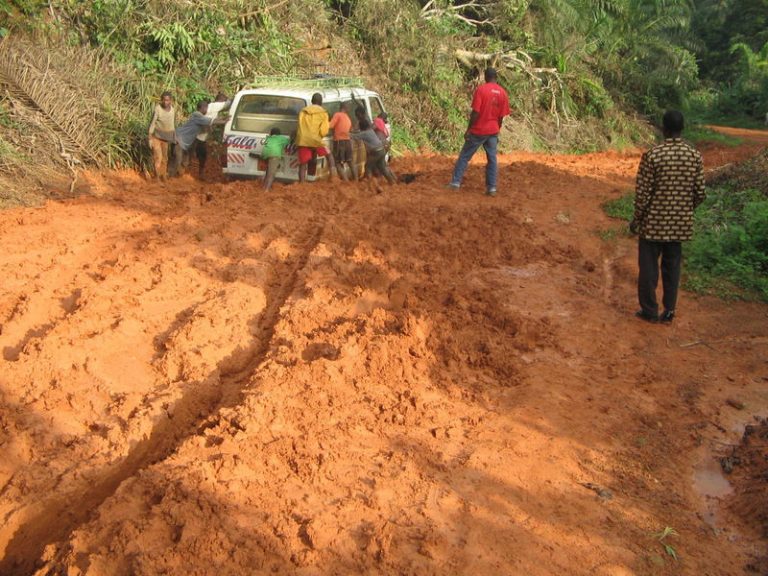
Local populations have goods but cannot easily bring them to market, not because roads are non-existent, but because there are too few quality roads. Even if funding issues are the reason for the lack of quality roads, it remove nothing on the fact that, way must be found to adapt to the situation, by carrying out ad hoc work as much as possible, with the aim of alleviating the hardships faced by road users. We are not saying it to say that, decentralized local authorities are not doing their job, or are not doing it poorly. Rather, what people expect from them is the proposition of alternative solutions that bring relief to village dweller, while awaiting more substantial funding. How can we prevent vehicles from getting stranded on the roads during the rainy season, for instance? How can we ensure relatively smooth traffic flow in both dry and raining seasons?

If we must be realistic and acknowledge that, opening up an entire Territory cannot happen overnight, or over the course of about ten years, we still need to take a more serious approach to three specific points: First, we must stop keeping the population under unrealistic expectations. Those seeking election or appointment, as well as those already elected or appointed, must stop promising things they have no intention of doing, or that current circumstances do not allow them to achieve.

When one is unable or has failed to deliver a project within the required timeframe, one must acknowledge the failure, and do one's utmost to not repeat past mistakes.

Those who know that they are serving the public, must provide permanent and concise reports on all the projects they manage, rather than sporadic updates that often bear no relation to the reality on the ground.

Secondly, one must learn to be content with one’s salary or legitimate benefits; it is unacceptable to have a wage, and also siphoning off funds that do not belong to us. Mismanagement must cease, making way for greater transparency in project implementation. Finally, the public must take responsibility by registering to electoral list, and electing candidates they truly believe, capable of improving their living conditions because, when half of the population do not expressed their voices during a major election, there is reasons for concern.

The State or decentralized local authorities, must see how it is possible subsidize fully or partially the transport of goods for villagers living in isolated areas. By waiving or reducing certain costs, they can offer at least to these communities the hope that paved roads, will one day reach in their villages, like those who, after decades of waiting, finally saw the arrival of infrastructure they had previously only witnessed elsewhere, and which is also become a reality which stimulate promising prospects for the decades ahead in their villages, and within a Territory that continues, despite everything, its long journey toward a higher-quality road network.

English|French

Ajouter un commentaire

Anti-spam